
If you are looking for the innocent meaning in Nepali, you will find that it isn’t just a single word. Depending on whether you are talking about a court case, a small child, or a simple mistake, the translation changes.
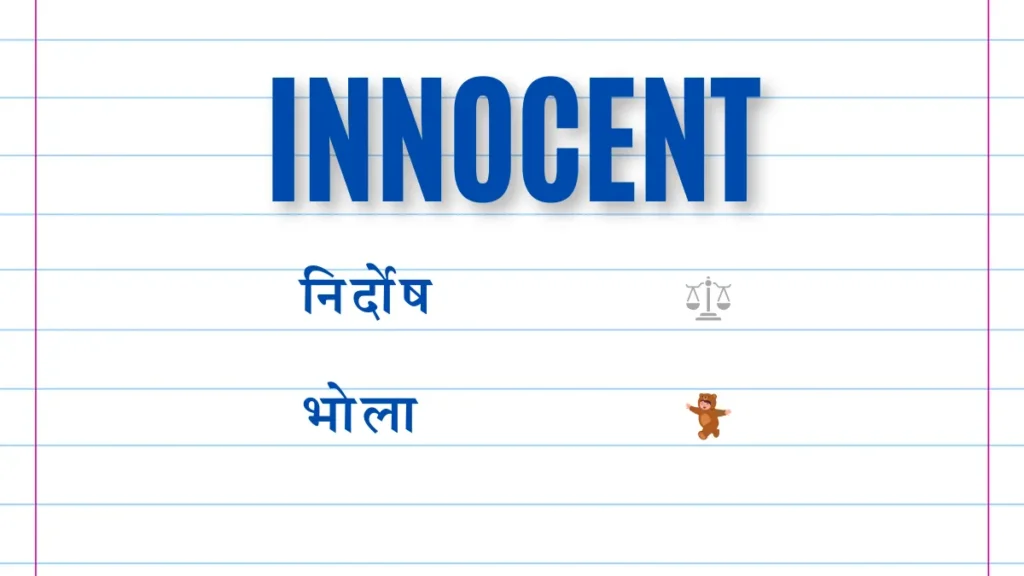
In Nepali, “innocent” translates most commonly to निर्दोष (Nirdosh), निष्पाप (Nishpap), or भोला (Bhola). When someone asks what does innocent mean in Nepali, they are usually looking for a term that captures purity, a lack of guilt, or a simple-hearted nature.
Deep Understanding of the Word Innocent
The word carries different shades of meaning based on the situation:
- Legal/Formal (Not Guilty): When someone didn’t commit a crime, the court declares them निर्दोष (Nirdosh). This is the official way to say someone is free from blame.
- Purity (Sinless): When describing a child’s heart or a spiritual state, we use निष्पाप (Nishpap). This implies someone who is free from “Paap” (sin).
- Personality (Simple-hearted): To describe someone who is gentle or perhaps a bit naive, the word is भोला (Bhola). A Bhola person trusts easily and hasn’t learned to be cunning yet.
When you use innocent in Nepali language, context matters deeply. Say Nirdosh with relief, and it means freedom from accusation. Say Bhola with a smile, and it’s endearing; say it with a smirk, and it might mean you think they are gullible.
Examples in Daily Conversation
Here are natural ways people translate innocent to Nepali in everyday life:
| English Sentence | Nepali Translation (Devanagari) | Romanized Nepali |
| That child has an innocent smile. | त्यो बच्चाको मुस्कान एकदम भोला छ। | Tyo bachchako muskan ekdam bhola chha. |
| He was proven innocent in court. | उनी अदालतमा निर्दोष साबित भए। | Uni adalatma nirdosh sabit bhaye. |
| It was just an innocent mistake. | त्यो त साधारण गल्ती मात्र थियो। | Tyo ta sadharan galti matra thiyo. |
| She has such an innocent heart. | उनको मन एकदम निष्पाप छ। | Unko man ekdam nishpap chha. |
| Don’t be so innocent, he’s lying. | यति भोला नबन, उसले झुट बोल्दै छ। | Yeti bhola naban, usle jhut boldai chha. |
(Pro Tip: If you want to understand the different ways to say “lying” in that last example, check out our guide on Lying Meaning in Nepali.)
Synonyms and Antonyms
To help you speak more fluently, here are related words and their opposites:
Synonyms (Similar Words)
- Pure – शुद्ध (Shuddha) / निष्कलंक (Nishkalank)
- Blameless – निर्दोष (Nirdosh) / दोषरहित (Doshrahit)
- Naive/Simple – भोलो (Bholo) / सरल (Saral)
Antonyms (Opposite Words)
- Guilty – दोषी (Doshi) / अपराधी (Apradhi)
- Corrupt – भ्रष्ट (Bhrasht)
- Cunning – चलाख (Chalakh) / धूर्त (Dhurt)
Final Thoughts
Language connects hearts before it defines words. Understanding innocent in Nepali isn’t just about memorizing Nirdosh or Bhola. It’s about feeling when to use which one.
Next time you hear someone described as “Bhola,” listen to the speaker’s tone. You’ll know instantly whether it’s a compliment or a warning. The words carry the speaker’s intention, not just dictionary definitions. Keep that awareness, and you’ll speak with real fluency on your journey to mastering the Nepali language.