
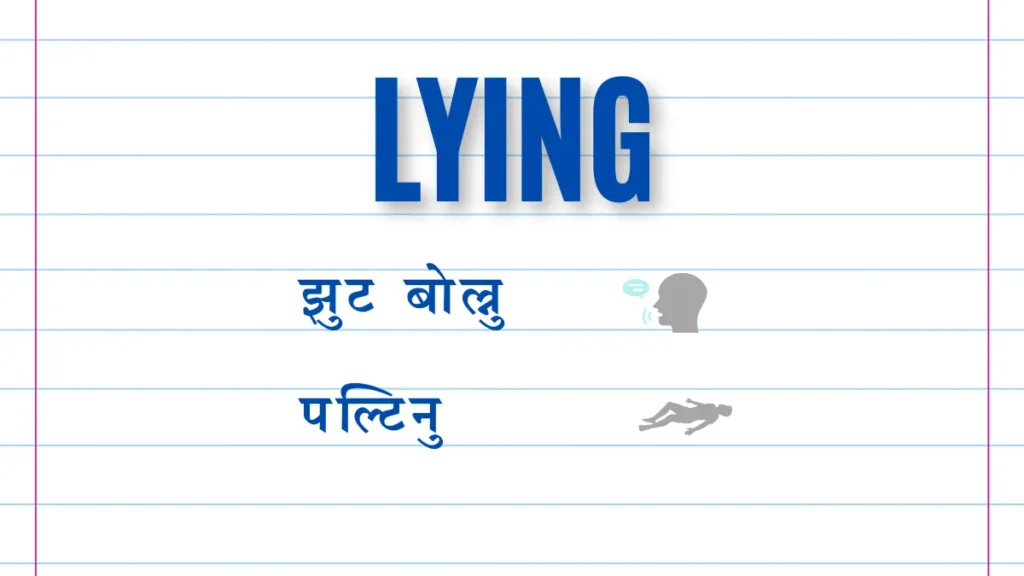
When you search for lying meaning in nepali, you’ll quickly realize something interesting. This single English word actually splits into two completely different Nepali words. Why? Because English uses “lying” for both dishonesty and for the simple act of resting flat on your back.
That’s where things get confusing for learners.
So what does lying mean in nepali? Well, it depends. Are we talking about someone who isn’t telling the truth? Or someone stretched out on a bed after a long day? The Nepali words for these two situations have nothing to do with each other.
Let me walk you through both.
When Lying Means Not Telling the Truth
If someone is hiding the truth or being dishonest, we don’t say they’re “lying” in Nepali the way English does. We say झुट बोल्दै (Jhut boldai) or ढाँट्दै (Dhantdai).
These come from the root verbs:
- झुट बोल्नु (Jhut bolnu) – to tell a lie. This is the standard term most people use.
- ढाँट्नु (Dhantnu) – to deceive or trick. You’ll hear this all the time in everyday conversations.
Growing up in Nepal, you’ve probably heard your parents say, “झुट नबोल!” (Jhut nabol!) which means “Don’t lie!” It’s one of those phrases burned into childhood memory. Honesty, or ईमानदारी (Imandari), carries a lot of weight in Nepali culture. Once someone catches you ढाँट्दै (lying), trust becomes hard to rebuild. विश्वास (Bishwas), or trust, is something you don’t get back easily.
When Lying Means Resting Down
Now, if you want to translate lying to nepali in the physical sense—like lying on a sofa, a mat, or grass under the sun—you’d say पल्टिरहेको (Paltiraheko) or सुतिरहेको (Sutiraheko).
Here’s how it breaks down:
- पल्टिनु (Paltinu) – to lie down horizontally, to rest flat.
- सुत्नु (Sutnu) – technically means “to sleep,” but Nepali speakers often use it just to mean lying in bed, even if you’re awake.
So when your friend texts asking what you’re doing and you reply, “म ओछ्यानमा सुतिरहेको छु” (Ma ochhyanma sutiraheko chhu), it just means you’re lying down. Maybe scrolling your phone. Maybe napping. Either way, you’re horizontal.
Real Everyday Examples
Here’s how lying in nepali language shows up in actual, daily use:
| English Sentence | Nepali Translation (Devanagari) | Romanized Nepali |
| He is lying to me. | उसले मलाई झुट बोल्दै छ। | Usle malai jhut boldai cha. |
| Why are you lying? | तिमी किन ढाँट्दै छौ? | Timi kina dhantai chhau? |
| I caught him lying. | मैले उसलाई झुट बोलेको समातेँ। | Maile uslai jhut boleko samate. |
| She is lying on the bed. | उनी ओछ्यानमा पल्टिरहेकी छिन्। | Uni ochhyanma paltiraheki chhin. |
| The book is lying on the table. | किताब टेबलमा राखिएको छ। | Kitab table-ma rakhieko cha. |
Words That Go With It
Let’s talk about words connected to the “dishonesty” meaning, since that’s what most people are curious about when they look this up.
Similar words:
- धोका दिनु (Dhoka dinu) – deceiving or betraying someone’s trust.
- बहाना गर्नु (Bahana garnu) – making excuses, pretending, faking.
- ठग्नु (Thagnu) – cheating or scamming, usually for personal benefit.
Opposite words:
- इमानदार (Imandar) – honest, truthful.
- सत्य (Satya) or साँचो (Sancho) – truth, the real thing.
- भरपर्दो (Bharpardo) – trustworthy, reliable, someone who won’t deceive you.
Why This Matters
Language isn’t just about memorizing translations. It reflects how a culture sees the world. English speakers can get away with one word doing double duty. Nepali doesn’t work that way. The language forces clarity. झुट बोल्नु and पल्टिनु are worlds apart, and mixing them up would sound odd, even funny.
If you’re learning Nepali or trying to communicate something sensitive—like explaining that someone lied to you, or just telling your mom you’re lying down for a bit—you need to know which word fits. Context changes everything.
Once you understand the lying meaning in nepali in both its forms, your conversations become smoother. You sound more natural. And honestly, that’s what learning a language is all about—not just getting the words right, but getting the feeling right too.